
The Rise of AI as a Service: Why US Companies are Investing for Smarter Solutions
Dec. 30, 2025
695

Table of Contents
- Key Takeaways
- What is AI as a Service?
- Why Are US Companies Rushing to Invest in AIaaS?
- Benefits
- How Are Different Industries Using AIaaS?
- What Should You Consider Before Adopting AIaaS?
- Which AIaaS Models Should You Consider?
- How Can You Get Started with AIaaS?
- Conclusion
- Frequently Asked Questions
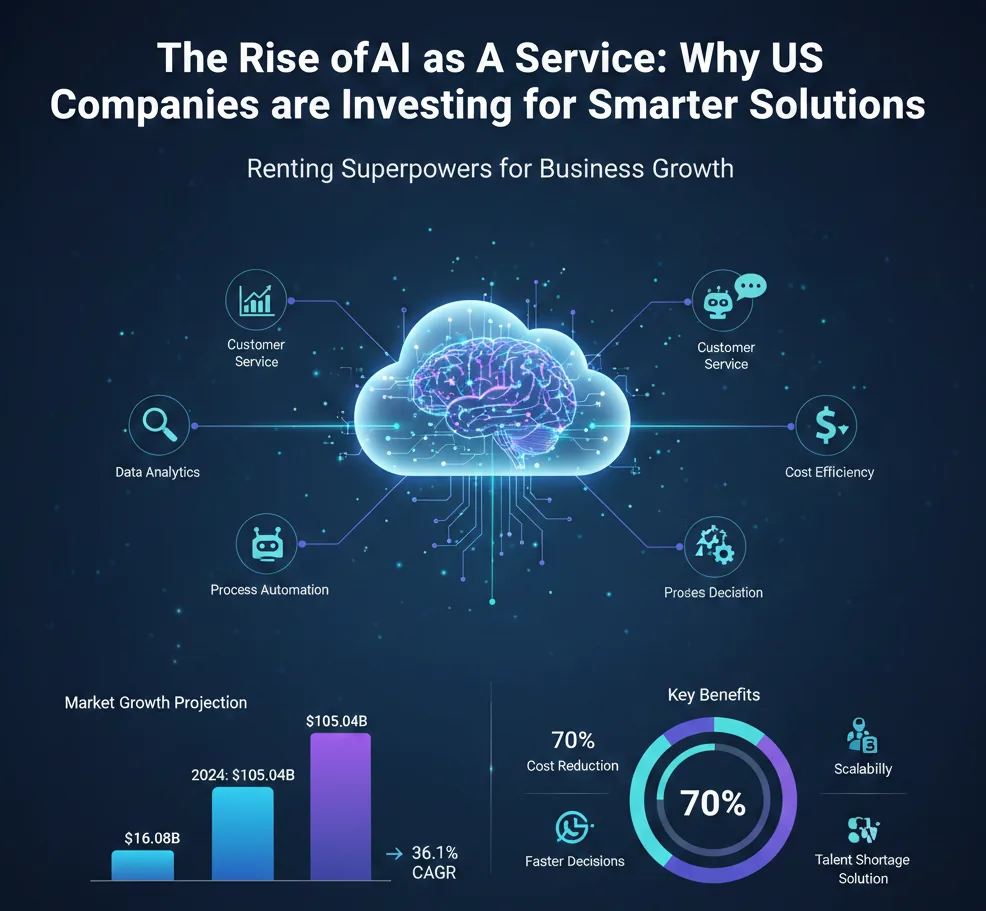
According to a comprehensive report by Grand View Research, the global AI as a Service market was valued at $16.08 billion in 2024 and is projected to reach an impressive $105.04 billion by 2030, growing at a remarkable CAGR of 36.1%.
This is like having access to powerful AI tools without spending millions on servers or hiring a team of data scientists. That's exactly what AIaaS offers, and US companies are jumping on board fast. Whether you're running a small startup or managing a large enterprise, AIaaS lets you use smart technology to automate tasks, understand your customers better, and make faster decisions. In simple terms, it's like renting superpowers for your business instead of building them from scratch.
In this article, we'll look into what AIaaS really means, why US companies are betting big on this technology, the key benefits driving adoption, and how you can leverage these solutions for your business growth. We'll also explore real-world applications and help you understand whether AIaaS is the right move for your organization.
Key Takeaways
|
Aspect |
Details |
|
Cost Efficiency |
Reduces AI implementation costs by up to 70% |
|
Main Drivers |
Scalability, accessibility, and reduced infrastructure needs |
|
Top Use Cases |
Customer service, data analytics, process automation |
|
Investment Focus |
Machine learning platforms, natural language processing, computer vision |
What is AI as a Service?
Let's see in detail what makes AIaaS different from traditional AI implementation. AIaaS is a cloud-based offering that allows you to access artificial intelligence capabilities without building and maintaining complex infrastructure. This model includes various AI technologies such as machine learning algorithms, natural language processing tools, computer vision systems, and speech recognition services. Major players like Amazon Web Services, Microsoft Azure, Google Cloud, and IBM Watson offer these services on a subscription basis, making advanced AI accessible to businesses that previously couldn't afford the investment.
You can also read about LMS vs. Custom Platform: Which EdTech Solution is Right for Your Business?
Why Are US Companies Rushing to Invest in AIaaS?
According to a report by Gartner, 79% of corporate strategists believe AI and analytics are critical to their success over the next two years. But what's driving this urgency?
The Cost Factor
Traditional AI implementation requires significant capital expenditure. You need data scientists, infrastructure, and months of development. AIaaS flips this model entirely. Companies can start with small-scale deployments, pay only for what they use, and scale as needed. This operational expenditure model reduces financial risk and accelerates time-to-value.
The Talent Shortage Solution
The US faces a critical shortage of AI specialists, with demand outpacing supply by nearly 3:1. AIaaS bridges this gap by providing pre-built models and automation tools that require minimal specialized knowledge. Your existing IT team can manage these services with proper training, eliminating the need to compete for scarce AI talent.
Speed to Market
In today's fast-paced business environment, speed matters. AIaaS enables rapid deployment of AI solutions, often within weeks instead of months or years. This agility gives companies a competitive edge, allowing them to test, iterate, and optimize quickly.
Benefits
According to a study by McKinsey, healthcare organizations implementing AI solutions see a productivity boost. When you implement AIaaS, the advantages extend far beyond cost savings. Let's explore the tangible benefits that are convincing executives to invest:
AIaaS platforms analyze vast amounts of data in real-time, providing insights that humans might miss. Predictive analytics help companies forecast trends, identify risks, and make data-driven decisions with confidence. Chatbots powered by AIaaS handle routine inquiries 24/7, while sentiment analysis helps you understand customer emotions and respond appropriately.Intelligent automation through AIaaS streamlines repetitive tasks, reduces errors, and frees your workforce to focus on strategic activities. Companies report productivity improvements of 30-40% in automated processes.
How Are Different Industries Using AIaaS?
|
Industry |
Primary AIaaS Application |
Impact |
|
Healthcare |
Diagnostic imaging, patient risk assessment |
40% faster diagnosis accuracy |
|
Retail |
Demand forecasting, personalized recommendations |
25% increase in sales conversion |
|
Finance |
Fraud detection, algorithmic trading |
60% reduction in fraudulent transactions |
|
Manufacturing |
Predictive maintenance, quality control |
30% reduction in downtime |
|
Marketing |
Customer segmentation, content optimization |
35% improvement in campaign ROI |
The healthcare sector, for instance, uses computer vision APIs to analyze medical images with accuracy matching or exceeding human radiologists. Retailers leverage machine learning services for inventory optimization and personalized marketing campaigns. Financial institutions deploy fraud detection systems that analyze millions of transactions in milliseconds, protecting both companies and customers from cyber threats.
Read about Why U.S. Companies Are Adopting AI as a Service for Competitive Advantage
What Should You Consider Before Adopting AIaaS?
While the benefits are compelling, successful AIaaS implementation requires strategic planning. Here are factors you need to evaluate:
Data Quality and Readiness: AI is only as good as the data you feed it. Before adopting AIaaS, ensure your data is clean, organized, and accessible. Poor data quality will undermine even the most sophisticated AI models.
Integration Capabilities: Your chosen AIaaS platform must integrate seamlessly with your existing systems. Check for API compatibility, data format requirements, and whether the service works with your current technology stack.
Security and Compliance: When you move AI processing to the cloud, data security becomes paramount. Verify that your AIaaS provider meets industry standards and compliance requirements like GDPR, HIPAA, or SOC 2.
Vendor Lock-in Risks: Understand the implications of committing to a specific provider. Can you easily migrate to another platform if needed? What happens to your data and models if you switch providers?
Which AIaaS Models Should You Consider?
AIaaS comes in several deployment models, each suited for different business needs:
Software as a Service (SaaS):
SaaS completes AI applications delivered over the internet. These require minimal technical expertise and include tools like sentiment analysis platforms or chatbot builders.
Platform as a Service (PaaS):
PaaS provides the infrastructure and tools for building custom AI applications. This model offers more flexibility and is ideal for companies with development resources.
Infrastructure as a Service (IaaS):
IaaS offers raw computing power and storage for AI workloads. This gives you maximum control but requires more technical expertise to manage.
For most businesses starting their AI journey, SaaS offerings provide the best balance of capability and ease of use. As your needs evolve, you can explore PaaS or hybrid approaches.
How Can You Get Started with AIaaS?
Beginning your AIaaS journey doesn't require a massive commitment. Start with these practical steps.
Firstly, look for processes that are repetitive, data-intensive, or require quick decision-making. Customer service, data analysis, and inventory management are common starting points.
Then, launch a pilot project with limited scope. This allows you to test the technology, measure results. Also ensure your team understands how to work with AI tools. Most AIaaS providers offer training resources and support to help you maximize value. You should continuously track performance metrics and refine your AI implementations.
Conclusion
The rise of AI as a Service represents a fundamental shift in how businesses leverage intelligence and automation. US companies are investing heavily because AIaaS delivers measurable results, improved efficiency, better customer experiences, and competitive advantages that translate directly to bottom-line growth. The accessibility and affordability of these solutions mean you no longer need to be a tech giant to benefit from cutting-edge AI.
When you're ready to modernize your applications and integrate AI capabilities, choosing the right partner makes all the difference. CodeSuite specializes in seamlessly incorporating AIaaS solutions tailored to your business needs. Our team helps you navigate the complexities of AI adoption, from strategy development to implementation and ongoing optimization.
Reach out to us for a consultation on how AIaaS can transform your operations and position your business for future success.
Frequently Asked Questions
Q: How much does AI as a Service typically cost? A: AIaaS follows a pay-as-you-go model. Basic services start at $100-500 monthly, while enterprise solutions range from $1,000-10,000+ depending on usage, features, and scale. This is significantly cheaper than building in-house AI infrastructure.
Q: Do I need technical expertise to use AIaaS? A: Not necessarily. Many AIaaS platforms offer user-friendly interfaces and pre-built models requiring minimal coding knowledge. However, some technical understanding helps maximize benefits and customize solutions to your specific needs.
Q: How secure is my data with AIaaS providers? A: Reputable AIaaS providers implement enterprise-grade security measures including encryption, access controls, and compliance certifications. Always review provider security policies and choose platforms that meet your industry's regulatory requirements.
Q: Can AIaaS integrate with my existing software? A: Most modern AIaaS platforms offer APIs and integration tools designed to work with common business software. Check compatibility with your current systems before committing to ensure smooth integration and data flow.
Q: What's the difference between AI as a Service and traditional software? A: Traditional software follows predetermined rules and logic, while AIaaS learns from data and improves over time. AIaaS adapts to patterns, makes predictions, and handles complex tasks that would be impossible with conventional programming.
Q: How quickly can I see results from AIaaS implementation? A: Many businesses see initial results within 4-8 weeks of deployment. However, full benefits typically emerge over 3-6 months as systems learn from your data and processes are optimized based on insights gained.